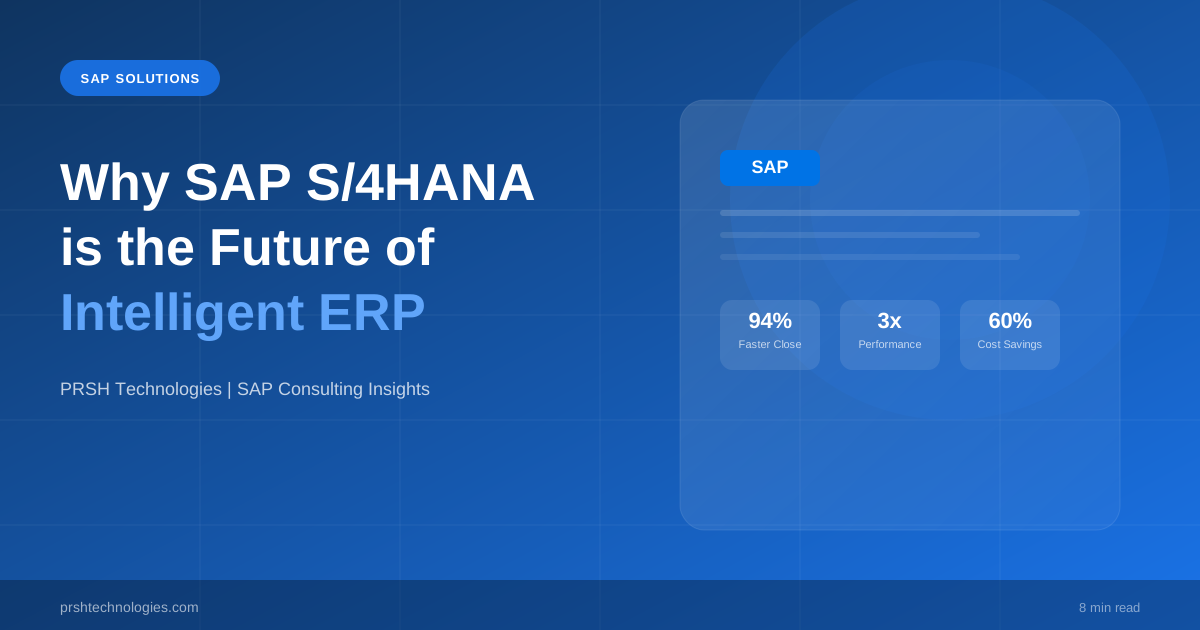
Discover why SAP S/4HANA is redefining the ERP landscape with real-time processing, embedded AI, and a cloud-native architecture that empowers enterprises to operate at unprecedented speed and intelligence.
The enterprise resource planning landscape is undergoing a seismic shift. For decades, ERP systems served as transactional record-keepers — powerful, but fundamentally retrospective. SAP S/4HANA changes that equation entirely, transforming the ERP from a system of record into a system of intelligence. For organisations serious about competing in a data-driven economy, understanding why SAP S/4HANA represents the future of ERP is not optional — it is strategic.
SAP S/4HANA is built on the SAP HANA in-memory database, a technology that processes analytical and transactional workloads simultaneously and at extraordinary speed. Traditional ERP systems separate these workloads across different databases and layers of aggregation — a design that creates latency, complexity, and operational blind spots. S/4HANA eliminates this separation, enabling organisations to run real-time simulations, close financial periods faster, and respond to operational disruptions within minutes rather than days.
The simplified data model is equally transformative. SAP S/4HANA reduces the number of database tables from tens of thousands to thousands, eliminating redundant aggregates and indexes that once slowed performance. The result is a leaner, faster, and far more maintainable system that positions organisations for the digital age.
Perhaps the most compelling differentiator of SAP S/4HANA is its deep integration of artificial intelligence and machine learning capabilities directly within business processes — not bolted on from outside, but woven into the fabric of how the system operates.
These capabilities are not features on a roadmap — they are available today and being used by thousands of organisations worldwide to drive measurable competitive advantage.
User adoption is one of the most cited reasons ERP projects fail to deliver expected value. SAP S/4HANA addresses this head-on with SAP Fiori — a role-based, consumer-grade user interface that delivers intuitive, contextual experiences across desktop, tablet, and mobile.
Unlike the complex transaction codes of legacy SAP systems, Fiori presents users with personalised dashboards, guided decision support, and one-click access to the information they need to do their jobs. The result is faster user adoption, lower training costs, and higher workforce productivity — all measurable outcomes that directly improve ROI.
SAP S/4HANA is available in three deployment models: on-premise, private cloud, and public cloud (SAP S/4HANA Cloud, Public Edition). This flexibility allows organisations at every stage of their cloud journey to leverage the platform's intelligent capabilities while maintaining the governance and compliance requirements of their industry.
For organisations choosing the cloud path, RISE with SAP provides a bundled migration offering that combines software, infrastructure, and services into a single subscription — dramatically simplifying the commercial and technical complexity of moving to the cloud. The managed cloud model also shifts infrastructure management to SAP, freeing internal IT teams to focus on business value rather than system maintenance.
In legacy ERP environments, running analytical reports often requires extracting data into a separate Business Warehouse system, a process that introduces latency and version conflicts. SAP S/4HANA eliminates this entirely. Analytical and transactional processing occur on the same in-memory database, meaning reports reflect the absolute current state of operations — no batch cycles, no overnight extracts, no stale data.
This capability is particularly powerful for financial close. Organisations using SAP S/4HANA Finance consistently report 50–70% reductions in financial close cycle times, enabling more frequent reporting, faster regulatory submissions, and better-informed strategic decisions.
Environmental, Social, and Governance (ESG) reporting is becoming a board-level priority and a regulatory requirement in many jurisdictions. SAP S/4HANA provides built-in sustainability management capabilities — including carbon footprint tracking, environmental compliance monitoring, and integration with SAP Sustainability Control Tower — enabling organisations to manage and report their sustainability commitments with the same rigour as financial data.
Organisations that have migrated to SAP S/4HANA consistently report significant business outcomes:
With SAP mainstream maintenance for ECC 6.0 extended to 2030 and SAP's clear investment direction squarely behind S/4HANA, the migration question is not whether to move — it is how to move strategically to maximise value and minimise disruption.
At PRSH Technologies, our SAP S/4HANA practice combines deep technical expertise with a pragmatic, business-outcome-focused approach. From readiness assessments and fit-gap analysis to full greenfield or system conversion implementations, our certified consultants guide enterprises through every phase of their S/4HANA journey.
We leverage proven methodologies — including SAP Activate — to deliver implementations that are on time, within budget, and built to evolve with your business. Our post-go-live support ensures your investment continues to deliver value long after the initial deployment.
PRSH Technologies offers a complimentary SAP S/4HANA Readiness Assessment to help you understand your current landscape, define the optimal migration path, and build a business case that justifies the investment. Connect with our SAP practice lead today.
Schedule a Free ConsultationGet SAP insights & tech updates delivered to your inbox.
Connect with PRSH Technologies' SAP experts for a free consultation and discover what's possible for your business.


No approved comments yet. Be the first to comment!