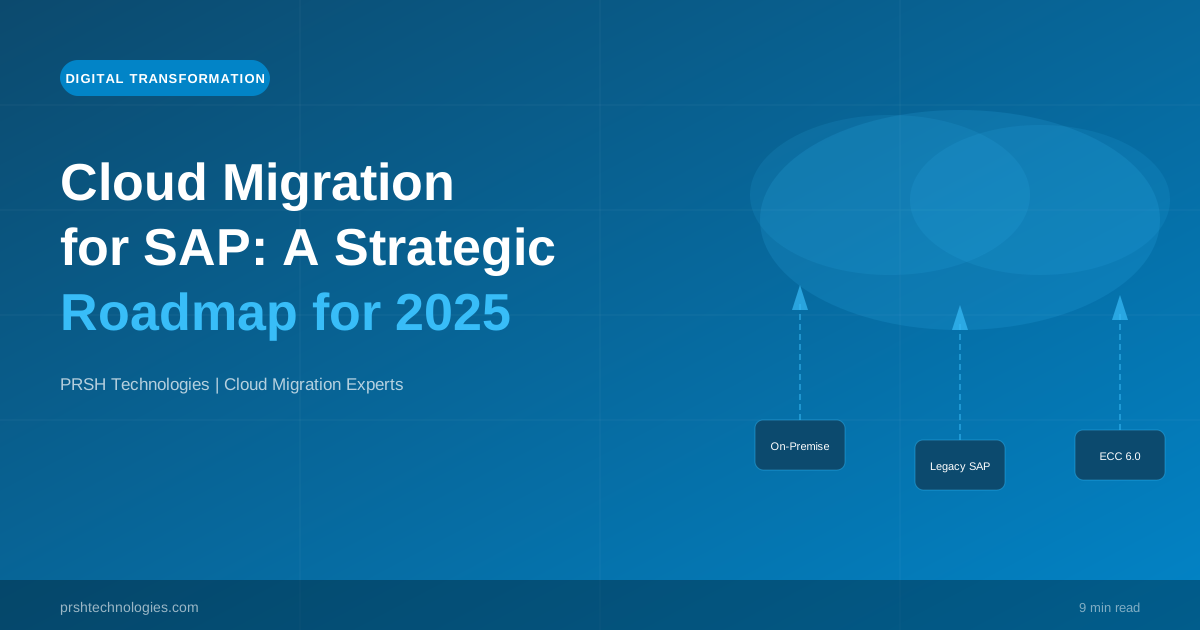
The clock is ticking on SAP ECC 6.0 support, and migrating to the cloud is no longer a question of if — only when and how. Explore the strategic roadmap that enterprise leaders are using to migrate SAP workloads to the cloud with confidence, speed, and minimal disruption.
The end of SAP mainstream maintenance for ECC 6.0 in 2030 — combined with the accelerating competitive advantage that cloud-native SAP S/4HANA delivers — has made cloud migration from a question of "whether" into a question of "how" and "when." Yet for many large enterprises, the complexity of migrating a mission-critical SAP landscape to the cloud feels daunting. This strategic roadmap breaks down the cloud migration journey into clear, manageable phases — drawing on the lessons of organisations that have already made the move.
A successful cloud migration begins with a rigorous understanding of the current state. This phase encompasses:
The cloud migration strategy involves several key decisions that shape the entire programme:
Deployment Model Selection: SAP S/4HANA is available in three cloud deployment models. SAP S/4HANA Cloud Public Edition provides a standardised, two-tier deployment with the fastest time to cloud and lowest TCO but limited customisation. SAP S/4HANA Cloud Private Edition (available through RISE with SAP) provides a single-tenant, managed cloud environment that supports a wider configuration and customisation range. On-premise or hosted private cloud remains appropriate for a small set of organisations with specific data sovereignty or integration requirements.
Migration Approach: Two primary migration paths exist. System Conversion (brownfield) migrates the existing SAP ECC system to S/4HANA, preserving historical data and most configurations — reducing migration scope but also limiting the extent to which business processes are re-engineered. New Implementation (greenfield) starts fresh on S/4HANA, using the migration as an opportunity to standardise and modernise business processes — requiring more initial investment but delivering a cleaner, more maintainable system.
Hyperscaler Selection: SAP on AWS, Azure, or Google Cloud — or SAP's own data centres — each offer different strengths in terms of existing cloud investment, data residency requirements, and complementary cloud services. Many organisations select the hyperscaler that best aligns with their broader cloud strategy.
Before migrating SAP workloads, the cloud infrastructure must be established and validated. This phase includes provisioning and configuring the cloud environment, establishing network connectivity between cloud and on-premise systems, implementing identity and access management, and validating security controls against the organisation's requirements. For RISE with SAP deployments, SAP and the chosen hyperscaler manage much of this infrastructure layer — significantly reducing the technical complexity of this phase.
Data migration is almost always the most effort-intensive and risk-bearing component of an SAP cloud migration. The approach should include:
Custom code identified in Phase 1 as requiring remediation must be updated for S/4HANA compatibility. Where possible, this is an opportunity to retire legacy customisations that can be replaced with standard S/4HANA capabilities or BTP extensions. Integration redesign is equally important: legacy point-to-point integrations should be redesigned using SAP Integration Suite on BTP, creating a more maintainable, monitored, and scalable integration architecture for the cloud era.
Comprehensive testing — including functional testing, integration testing, user acceptance testing, and performance testing — is the final quality gate before go-live. A phased go-live approach — migrating by geography, business unit, or process area — reduces risk compared to a single big-bang cutover and enables the organisation to learn and adjust between phases.
Post-go-live hypercare — a dedicated period of intensive monitoring and support — ensures stability is achieved quickly and user adoption challenges are addressed before they erode confidence in the new system.
For many organisations, RISE with SAP provides the most commercially and operationally practical path to cloud. By bundling SAP S/4HANA Cloud Private Edition, SAP BTP credits, business process intelligence, and managed cloud infrastructure into a single subscription, RISE with SAP simplifies the commercial model, reduces the number of vendors to manage, and accelerates the cloud migration timeline. PRSH Technologies is an authorised RISE with SAP partner, helping organisations evaluate, negotiate, and execute RISE with SAP engagements.
PRSH Technologies guides enterprises through every phase of their SAP cloud migration — from initial landscape assessment and business case development to programme delivery and post-go-live optimisation. Our certified migration specialists have deep experience with both system conversion and greenfield approaches. Contact us to begin your migration planning.
Plan Your Cloud MigrationGet SAP insights & tech updates delivered to your inbox.
Connect with PRSH Technologies' SAP experts for a free consultation and discover what's possible for your business.



No approved comments yet. Be the first to comment!