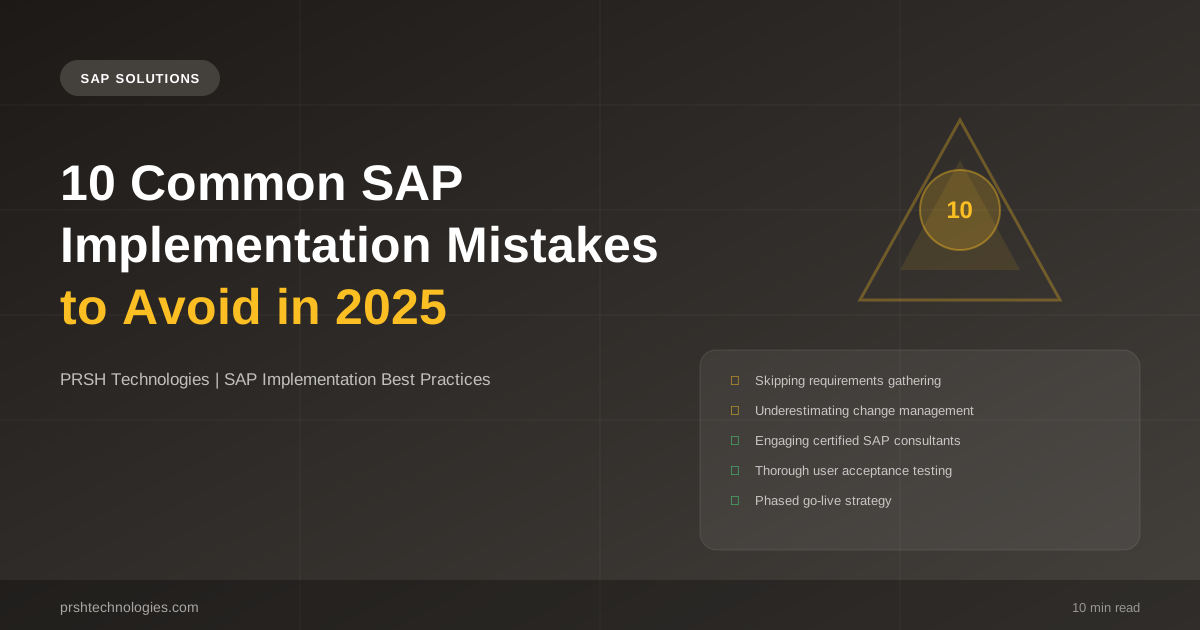
A successful SAP implementation can transform your business. A failed one can cost millions and set operations back by years. Based on deep consulting experience, here are the ten most common SAP implementation mistakes — and the proven strategies to avoid them.
SAP implementations are among the most complex and consequential technology programmes any organisation undertakes. When they succeed, they transform operations, enable growth, and deliver competitive advantage for years. When they fail — or underperform — the consequences are severe: budget overruns, schedule delays, user frustration, and business disruption that can take years to recover from. After years of working alongside clients through SAP implementations of all scales and types, the PRSH Technologies team has identified the ten most common mistakes — and the proven approaches that prevent them.
The most expensive problems in any SAP implementation have their roots in the requirements phase. When business requirements are vague, incomplete, or captured only from IT without adequate business stakeholder involvement, the implementation team builds a system that works technically but fails operationally. Invest heavily in the requirements phase — conduct thorough process workshops, document current-state and future-state processes in detail, and validate requirements with the people who will actually use the system every day.
SAP implementations do not just change systems — they change how people work. Organisations that treat change management as an afterthought consistently struggle with low user adoption, workaround behaviours, and the slow erosion of the business value the implementation was designed to deliver. Start change management activities from day one of the project, invest in comprehensive training, and create visible executive sponsorship that signals the importance of the transformation to the entire organisation.
The temptation to replicate legacy system behaviour in SAP — through custom code or complex configuration — is one of the most persistent and costly mistakes in SAP implementations. Excessive customisation creates upgrade complexity, increases maintenance cost, introduces defects, and often preserves outdated processes that should have been re-engineered. Adopt a clean-core philosophy: start with SAP standard, challenge the need for every deviation, and use SAP BTP side-by-side extensions for genuine business requirements that standard SAP cannot meet.
Data migration is routinely underestimated in terms of both complexity and effort. When data quality issues are discovered late in the programme — data that is incomplete, inconsistent, or structured incorrectly for the target SAP model — the consequences are severe: scope creep, schedule delays, and a go-live on bad data that undermines user confidence immediately. Begin data migration activities early, invest in data cleansing before migration, and run multiple mock migration cycles to validate data quality and loading performance before the actual go-live.
Testing is the discipline that prevents production surprises. Yet in time- and budget-pressured implementations, testing is often the first area to be cut. Abbreviated unit testing, insufficient integration testing, and skipped regression testing create a system that appears functional in isolation but fails under real-world operational conditions. Invest in a comprehensive test strategy — covering unit, integration, user acceptance, and performance testing — and treat defect resolution as a critical path activity, not a post-go-live cleanup task.
SAP implementations require sustained executive attention and decision-making authority. When issues arise — and they always do — only empowered executive sponsors can make the tough calls on scope, budget, and schedule trade-offs. Organisations where executive attention drifts during the implementation consistently experience drift in project direction, delayed decisions, and a gradual loss of business stakeholder commitment that undermines go-live success.
Training that is too brief, too close to go-live, and too focused on system mechanics rather than on how roles will actually change is a recipe for low adoption. Effective SAP training is role-specific, scenario-based, and delivered with enough lead time that users feel genuinely prepared for the new system on day one. Consider super-user networks — power users embedded in each business area — who can provide peer-to-peer support during the critical post-go-live period.
SAP does not operate in isolation — it connects to dozens of other systems across the enterprise landscape. Integration complexity is frequently underestimated in scope, effort, and testing time. Create a comprehensive integration inventory early in the project, design integrations using robust, maintainable approaches (ideally through SAP Integration Suite on BTP), and test integrations rigorously under realistic data volumes and transaction loads.
The go-live is not the end of the implementation — it is the beginning of the most critical phase. The weeks immediately following go-live are characterised by high incident volumes, user questions, and business process adjustments as teams adapt to the new system. Organisations without a robust hypercare plan — including dedicated support resources, escalation paths, and a mechanism for rapidly triage-ing and resolving production issues — risk a go-live that deteriorates into a crisis rather than stabilising into success.
SAP is not a system you implement and forget — it is a platform that should continuously evolve with your business. Organisations that fail to invest in ongoing optimisation, regular system updates, and continuous improvement programmes gradually find their SAP investment delivering diminishing value as the system drifts from business needs and falls behind the innovation SAP delivers in new releases. Build a run-and-optimise capability from day one, and treat your SAP investment as a continuously evolving strategic asset.
PRSH Technologies has delivered SAP implementations across multiple industries, consistently achieving on-time, within-budget go-lives with high user adoption. Our proven methodology — built around the lessons above — helps organisations navigate the complexity of SAP implementation with confidence. Connect with our project delivery team to discuss your upcoming SAP programme.
Talk to Our SAP Implementation TeamGet SAP insights & tech updates delivered to your inbox.
Connect with PRSH Technologies' SAP experts for a free consultation and discover what's possible for your business.




No approved comments yet. Be the first to comment!